
Every app on your phone looks simple from the outside. You tap an icon, something opens, you scroll, you close it. It feels instant and almost effortless. That simplicity is an illusion. Underneath that clean interface is a layered system of infrastructure, services, and logic that is far closer to controlled chaos than the smooth experience you see on screen.
Apps Are Built in Layers, Not Lines
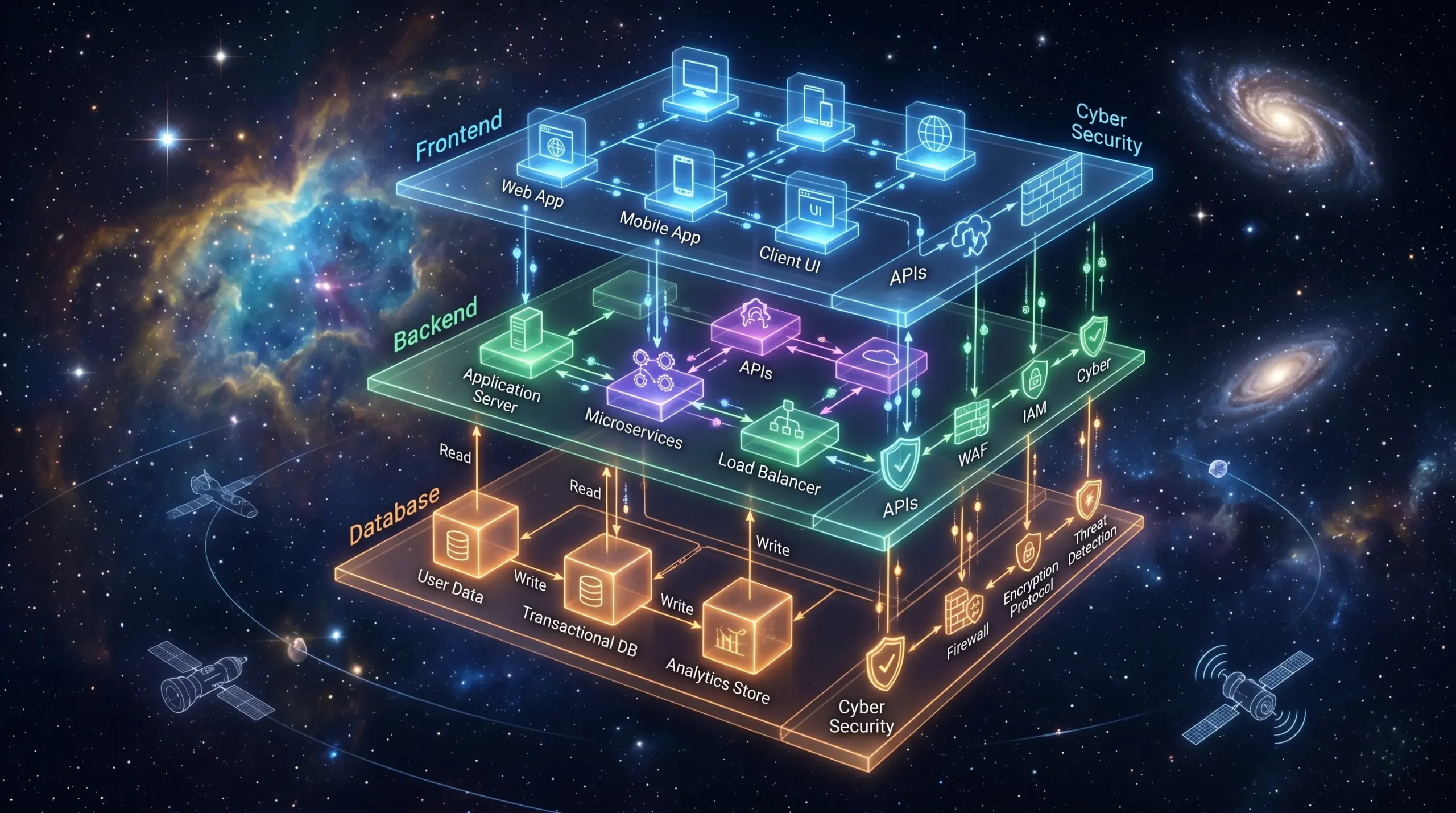
Modern applications are not single programs. They are stacked systems, each responsible for a specific part of the experience. At a high level, most apps are structured like this:
- Frontend: the interface you interact with
- Backend: the logic that processes requests and decisions
- Database: the system that stores and retrieves persistent data
- APIs: communication channels that allow different systems to exchange information
Each layer depends on the others, and none of them function meaningfully in isolation. The frontend is what you see, but it is also the least important part in terms of actual computation. It is essentially a presentation layer sitting on top of much heavier machinery.
What Happens When You Open an App
Opening something like Instagram is not a single action. It is a chain reaction. Your device sends requests to servers. Those servers communicate with databases that store user data, preferences, and relationships. Caching systems retrieve frequently accessed content to reduce delay. Multiple services coordinate in real time to assemble what you see as a simple feed. This entire process happens in milliseconds.
To the user, it looks like an app loading. In reality, it is distributed systems across multiple regions synchronizing data, resolving requests, and constructing a personalized response.
The Fragile Illusion of Stability
What makes this architecture interesting is how fragile it actually is. A small failure in one layer can cascade:
- a slow database query can delay entire feeds
- an overloaded server can degrade performance globally
- a broken API can prevent features from loading entirely
The user experience remains smooth only as long as every layer performs its role correctly and in sync. When it does not, the illusion breaks immediately.
Software Is Not a Perfect Machine
There is a common misconception that software is precise and clean. In reality, modern systems are closer to evolving ecosystems than engineered machines. They rely on:
- redundancy to prevent failure
- caching to reduce load
- distributed systems to scale globally
- constant updates to fix unpredictable behavior
This is not elegance in the traditional sense. It is maintenance at scale. A more accurate description of many modern systems is this: carefully managed instability that appears stable from the outside.
Why This Matters
Understanding this structure changes how you view technology. Apps are not magic. They are not simple. They are layered systems of interdependent components constantly negotiating performance, speed, and reliability. The simplicity you experience is not because the system is simple. It is because the complexity has been hidden well enough to feel invisible.
Every tap on your screen triggers far more than a single action. It activates a distributed system designed to simulate simplicity on top of extreme complexity. What you see is the interface. What exists underneath is a coordinated system that is always one small failure away from reminding you how fragile that simplicity really is.