Home Blog

The Hidden Architecture Behind Every App You Use

Every app on your phone looks simple from the outside. You tap an icon, something opens, you scroll, you close it. It feels instant and almost effortless. That simplicity is an illusion. Underneath that clean interface is a layered system of infrastructure, services, and logic that is far closer to controlled chaos than the smooth experience you see on screen.

Apps Are Built in Layers, Not Lines

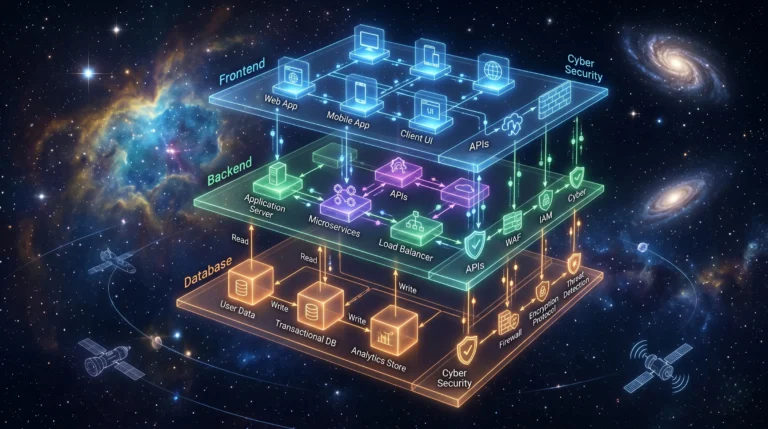
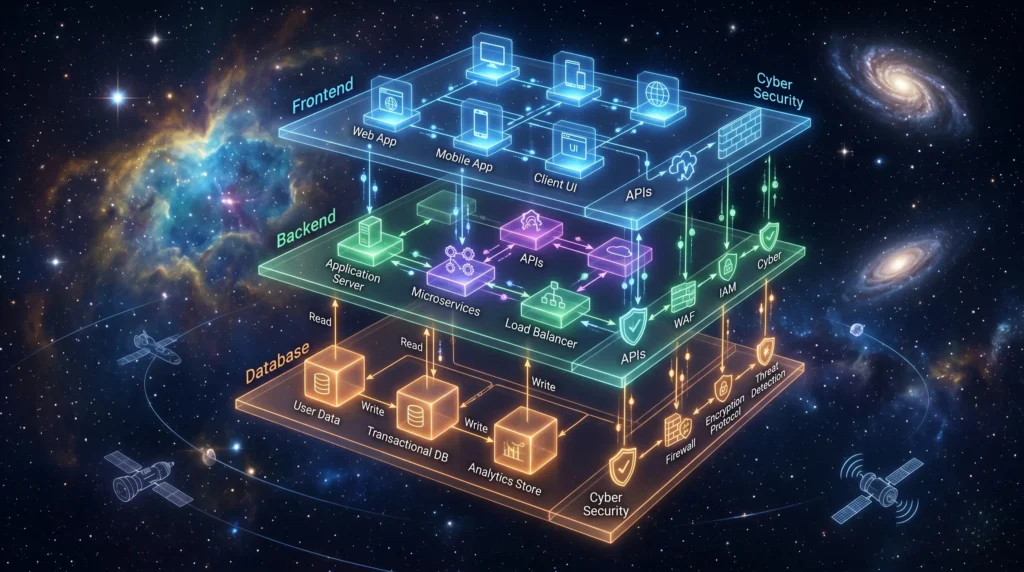
Modern applications are not single programs. They are stacked systems, each responsible for a specific part of the experience. At a high level, most apps are structured like this:

  • Frontend: the interface you interact with
  • Backend: the logic that processes requests and decisions
  • Database: the system that stores and retrieves persistent data
  • APIs: communication channels that allow different systems to exchange information

Each layer depends on the others, and none of them function meaningfully in isolation. The frontend is what you see, but it is also the least important part in terms of actual computation. It is essentially a presentation layer sitting on top of much heavier machinery.

What Happens When You Open an App

Opening something like Instagram is not a single action. It is a chain reaction. Your device sends requests to servers. Those servers communicate with databases that store user data, preferences, and relationships. Caching systems retrieve frequently accessed content to reduce delay. Multiple services coordinate in real time to assemble what you see as a simple feed. This entire process happens in milliseconds.

To the user, it looks like an app loading. In reality, it is distributed systems across multiple regions synchronizing data, resolving requests, and constructing a personalized response.

The Fragile Illusion of Stability

What makes this architecture interesting is how fragile it actually is. A small failure in one layer can cascade:

  • a slow database query can delay entire feeds
  • an overloaded server can degrade performance globally
  • a broken API can prevent features from loading entirely

The user experience remains smooth only as long as every layer performs its role correctly and in sync. When it does not, the illusion breaks immediately.

Software Is Not a Perfect Machine

There is a common misconception that software is precise and clean. In reality, modern systems are closer to evolving ecosystems than engineered machines. They rely on:

  • redundancy to prevent failure
  • caching to reduce load
  • distributed systems to scale globally
  • constant updates to fix unpredictable behavior

This is not elegance in the traditional sense. It is maintenance at scale. A more accurate description of many modern systems is this: carefully managed instability that appears stable from the outside.

Why This Matters

Understanding this structure changes how you view technology. Apps are not magic. They are not simple. They are layered systems of interdependent components constantly negotiating performance, speed, and reliability. The simplicity you experience is not because the system is simple. It is because the complexity has been hidden well enough to feel invisible.

Every tap on your screen triggers far more than a single action. It activates a distributed system designed to simulate simplicity on top of extreme complexity. What you see is the interface. What exists underneath is a coordinated system that is always one small failure away from reminding you how fragile that simplicity really is.


Your Attention Span Is Being Hacked (And You’re Letting It Happen)

If you struggle to sit through a short video without reaching for your phone, it is not a personal flaw or a lack of discipline. It is the outcome of systems designed to fragment attention at scale. Modern digital platforms are not neutral environments. They are engineered ecosystems competing for the most limited resource you have: sustained focus.

What feels like “normal scrolling” is actually a carefully optimized feedback loop built to keep you engaged longer than you intended.

The Attention Economy Is Not Abstract

Most people underestimate how intentional these systems are. Social platforms, short-form video apps, and content feeds are not simply showing you content. They are continuously testing what keeps you engaged.

The core mechanism is simple:

Uncertainty drives engagement. Every swipe introduces a variable reward:

  • a useful post
  • something entertaining
  • something emotionally stimulating
  • or nothing meaningful at all

That unpredictability is not a side effect. It is the design. Your brain is wired to resolve uncertainty. These systems exploit that wiring repeatedly, turning casual use into habitual checking.

What This Does to Your Mind Over Time

The impact is rarely obvious in a single session. It accumulates gradually, which is why it is so effective. Over time, this pattern leads to:

  • reduced ability to maintain focus on a single task
  • increased tolerance for constant stimulation
  • weaker memory retention from consumed content
  • a persistent sense of mental busyness without output

This is not about intelligence. It is about cognitive fragmentation. Your attention is being divided into smaller and smaller units until deep focus feels unnatural. The result is a subtle but consistent shift: consumption increases while comprehension decreases.

Why “Just Use It Less” Fails

Most advice around digital distraction fails because it assumes intention is enough to override design. It is not. These systems are built to minimize friction. You do not consciously decide to spend an hour scrolling. You repeatedly accept micro-invites that require almost no decision-making effort. That is why willpower-based solutions collapse quickly. You are not fighting a habit. You are fighting an interface optimized against restraint.

How Attention Gets Reclaimed in Practice

Reclaiming attention is not about rejection of technology. It is about reintroducing friction and control into systems designed to remove both. Effective adjustments tend to be structural rather than motivational:

  • disable non-essential notifications so attention is not externally triggered
  • remove infinite-feed entry points where possible
  • deliberately complete content instead of switching between inputs
  • introduce time boundaries for passive consumption

The objective is not restriction. It is restoration of intentional use. When friction returns, automatic behavior weakens. That is where control starts to reappear.

Attention as the Primary Resource

Attention is often treated as something abundant because it resets daily. In practice, it behaves more like a budget that is spent across competing demands. Every platform, app, and interface is effectively bidding for that budget. The key shift in understanding is this:
you are not just using technology. You are allocating attention within a system designed to optimize its extraction.

Once that becomes visible, usage stops being passive.

The issue is not that attention spans are “naturally declining.” It is that attention is being continuously trained into shorter cycles by design environments that reward fragmentation. The advantage belongs to anyone who can sustain focus longer than the systems competing for it. Not because they are more disciplined, but because they are less interrupted.

Why AI Isn’t Replacing You (But Someone Using AI Probably Is)

Introduction

There’s a growing panic online that AI is coming for everyone’s jobs like some kind of sci-fi takeover event. The narrative sounds dramatic enough to belong in a movie, but reality is far less cinematic and way more inconvenient.

AI isn’t replacing people in general. It’s replacing a very specific group of people: the ones who refuse to use it.

That difference is where everything is quietly shifting.

AI Isn’t the Enemy, Ignorance Is the Limitation

AI gets treated like it has intentions. It doesn’t. It’s not plotting career extinction or sitting in a virtual villain chair planning your downfall. It’s a tool. A very fast, very scalable one. Think about calculators. When they were introduced, mathematicians didn’t disappear. People who avoided them just became slower compared to everyone else. Same pattern. Different century. The advantage didn’t go to “machines.” It went to people who learned how to use them properly.

The Real Shift: Human vs Human (With Unequal Tools)

The real competition today isn’t humans versus AI. It’s: Human + AI vs Human without AI ; One side is working with tools that can draft, analyze, summarize, and generate ideas in seconds. The other side is manually doing everything from scratch, hoping effort alone compensates for efficiency. It usually doesn’t. This is not about intelligence. It’s about leverage.

What AI Actually Helps With

AI is already being used across almost every knowledge-based field:

  • Writing and content creation
  • Coding and debugging
  • Data analysis and pattern recognition
  • Design ideation and prototyping
  • Brainstorming when your brain is running low battery

It doesn’t “replace thinking.” It speeds up parts of thinking that are repetitive, structured, or time-consuming.
That leaves humans to focus more on direction, judgment, and creativity instead of raw execution.

The Real Risk Isn’t Replacement, It’s Stagnation

Ignoring AI doesn’t freeze your current skills. It slowly devalues them. While you’re doing everything manually, others are:

  • shipping faster
  • testing more ideas
  • learning quicker
  • iterating at scale

At some point, it’s not even a comparison anymore. It’s just different tiers of speed. And in most industries, speed quietly becomes opportunity.

Adaptation Is the Actual Skill

The important skill isn’t “knowing AI tools.” It’s knowing:

  • when to use them
  • what to delegate
  • how to verify outputs
  • how to combine them with human thinking

AI doesn’t reward passive users. It rewards people who actively shape it into their workflow.

AI isn’t replacing people in a simple, dramatic way. It’s reshaping what “being effective” even means. The real divide is no longer between humans and machines. It’s between people who adapt to new tools and people who don’t. And the gap between those two groups is only going to get wider.